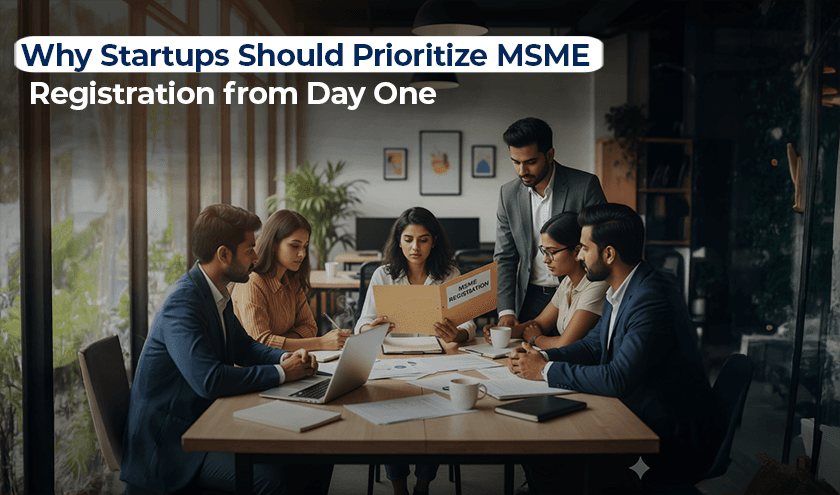
Why Startups Should Prioritize MSME Registration from Day One
Are You Missing Out on MSME Benefits as a Startup?
Imagine this: You’ve just launched your dream startup. You’ve got a brilliant product, a small but dedicated team, and a clear mission. But while you’re busy developing, pitching, and selling—have you considered registering as an MSME?
If not, you could be missing out on tax breaks, funding access, legal protections, and schemes designed specifically for startups and small businesses. MSME registration can be a game-changer—especially when done from day one.
In this blog, we'll break down what MSME registration is, how it helps startups, and why legal guidance from a startup lawyer (especially if you're based in Delhi or another startup hub) can save you time, money, and stress.
What You’ll Learn
- What MSME registration means and how it differs from startup registration
- Key legal and financial benefits for new businesses
- Step-by-step guide to MSME registration in India
- Real-world examples of startups that gained from early registration
- How VakeelSaab can help you navigate the process legally and efficiently
Understanding MSME Registration: The Basics
What is MSME Registration?
MSME stands for Micro, Small, and Medium Enterprises. The Government of India classifies businesses under these categories based on investment and turnover limits. MSME registration is a formal recognition that qualifies your business for various schemes and protections under the MSME Development Act, 2006.
- Micro Enterprise: Investment < ₹1 crore and turnover < ₹5 crore
- Small Enterprise: Investment < ₹10 crore and turnover < ₹50 crore
- Medium Enterprise: Investment < ₹50 crore and turnover < ₹250 crore
MSME registration is entirely online through the Udyam Registration Portal and is free of cost.
MSME vs Startup Registration India
Many founders confuse MSME registration with Startup India registration. Here's the difference:
MSME Registration
Startup India Registration
Focused on enterprise size and turnover
Focused on innovation and scalability
Offers tax, loan, and subsidy benefits
Offers tax holidays, funding access, and branding
Administered by Ministry of MSME
Administered by DPIIT under the Ministry of Commerce
More inclusive for traditional or service-based businesses
Targeted at tech-driven or innovative startups
Pro tip: You can apply for both to maximize your startup’s support ecosystem.
Why MSME Registration Should Be a Priority for Startups
1. Access to Government Schemes and Subsidies
From collateral-free loans to credit-linked capital subsidies, MSMEs enjoy privileged access to several financial benefits under schemes like:
- Credit Guarantee Fund Trust for Micro and Small Enterprises (CGTMSE)
- Prime Minister Employment Generation Programme (PMEGP)
- Interest Subvention Scheme for MSMEs
These schemes are available only if you’re officially registered as an MSME.
2. Faster Approvals and Easier Compliance
Once registered, MSMEs get priority in:
- Government procurement (with relaxed norms)
- Environmental and labour compliance
- IP and trademark registration processes (with fee rebates)
3. Tax Benefits and Easier Finance Access
Banks and NBFCs often prioritize MSME-registered startups for:
- Lower interest rates
- Quicker loan disbursement
- Reduced paperwork
Additionally, you may be eligible for tax concessions under both MSME and Startup India frameworks.
4. Legal Safeguards Against Delayed Payments
Under the MSME Development Act, if a buyer delays payments beyond 45 days, you're entitled to interest at three times the bank rate. That’s a powerful legal tool—especially for service-based startups or small product suppliers.
Common Misconceptions About MSME Registration
“We’re a tech startup. MSME doesn’t apply to us.” Wrong. MSME registration applies to all business sectors—manufacturing, services, even SaaS and IT.
“We’ll register later when we grow.” Delaying registration means losing early access to benefits, funding, and compliance reliefs.
“It’s a long, complicated process.” Not true. The Udyam Registration process is streamlined and takes less than an hour—with the right documentation and guidance.
How to Register Your Startup as an MSME (Udyam Registration)
Here’s a step-by-step breakdown:
Step 1: Gather Required Documents
- Aadhaar number of the business owner
- PAN number
- GSTIN (if applicable)
- Business address proof
- Bank details
Step 2: Visit the Udyam Portal
Go to udyamregistration.gov.in. It’s the only official portal—beware of third-party agents charging fees.
Step 3: Fill Out the Online Form
Input details like:
- Type of organization
- PAN and GST details
- Investment and turnover figures
- Nature of business activity
Step 4: Self-Declaration and Submission
No uploads required—just accurate self-declaration. Once submitted, you’ll get an Udyam Registration Number and certificate.
Optional: Link Your MSME Registration with Startup India Scheme
This can be done via the Startup India portal. You’ll need an innovation-focused pitch and other supporting docs.
Real-World Example: MSME Benefits for Startups
Case Study – Delhi-Based Logistics Startup
A logistics startup with under ₹3 crore turnover approached VakeelSaab for MSME registration. Within three months of registering:
- They secured a collateral-free working capital loan
- Received ₹2 lakh under a state-level MSME subsidy
- Protected themselves legally from a large corporate client who delayed payment beyond 60 days
Takeaway: Without MSME registration, they would have had no legal recourse or financial support.
Legal Best Practices for MSME Startups
- Register early: Preferably before any major contracts or funding rounds
- Keep documents updated: PAN, GSTIN, business classification, and investment/turnover records
- Use a startup lawyer: Especially in cities like Delhi, where overlapping registrations and legal complexities can arise
- Don’t skip Startup India registration: When combined with MSME status, it unlocks greater support
- Renew and update details annually on the Udyam portal
Why Work with a Startup Lawyer in Delhi?
While the process might appear simple, there are often hidden challenges:
- Choosing the right business structure before MSME registration
- Ensuring compliance with both central and state-level MSME schemes
- Drafting legal documents that protect you in MSME-related disputes
At VakeelSaab, our startup lawyers in Delhi specialize in:
- MSME registration assistance
- Navigating the Startup India scheme
- Legal document vetting for investor and vendor agreements
- Payment recovery under MSME Act
Whether you're a solo founder or a growing startup, we’re here to guide you from incorporation to growth—legally and strategically.
Ready to Register Your Startup as an MSME?
Don’t wait until a payment delay or funding rejection forces you to act. Proactive legal and regulatory steps taken now can save your startup months of hassle and lakhs in losses.
Contact VakeelSaab today for a personalized legal consultation. We’ll guide you through MSME registration, Startup India benefits, and more.
FAQ: MSME for New Businesses
Q1: Is MSME registration mandatory for startups? No, it’s voluntary—but highly recommended to access financial and legal benefits.
Q2: Can I apply for both MSME and Startup India registration? Yes. In fact, combining both offers broader support and credibility.
Q3: How long does the MSME registration process take? Usually less than 24 hours if all details are correctly submitted.
Q4: Are there any fees involved? The official Udyam registration is 100% free.
Q5: What’s the validity of MSME registration? As long as your business continues to meet the investment and turnover limits.
Related Articles
The Importance of Consulting a Property Lawyer for Real Estate Issues
Blog
How to File a POCSO Complaint in India: Step-by-Step Legal Process
Blog
What punishments does the law give for giving, taking, or asking for dowry?
Blog
Reasons for the Increasing Divorce Rates in India
Blog
What is a Special Leave Petition? Meaning, Features, Process & & Who Can File?
Blog
What Is the Difference Between Mutual Divorce and Contested Divorce?
Blog